
Status: Proposed · September 2026
A year-old house on Trimble Road in Green Hills with a segmental block retaining wall along the rear — five to seven courses plus cap, fence on top — that has moved more than a segmental wall should. About 42 feet of visible bulge, a sinkhole reopening behind it, and almost no flow out of the corrugated drain at the corner. An engineer’s report found a backfill void roughly 20 inches deep directly behind the wall and water emerging from under it rather than through the pipe. The homeowners’ first question was whether the wall needed to be rebuilt.
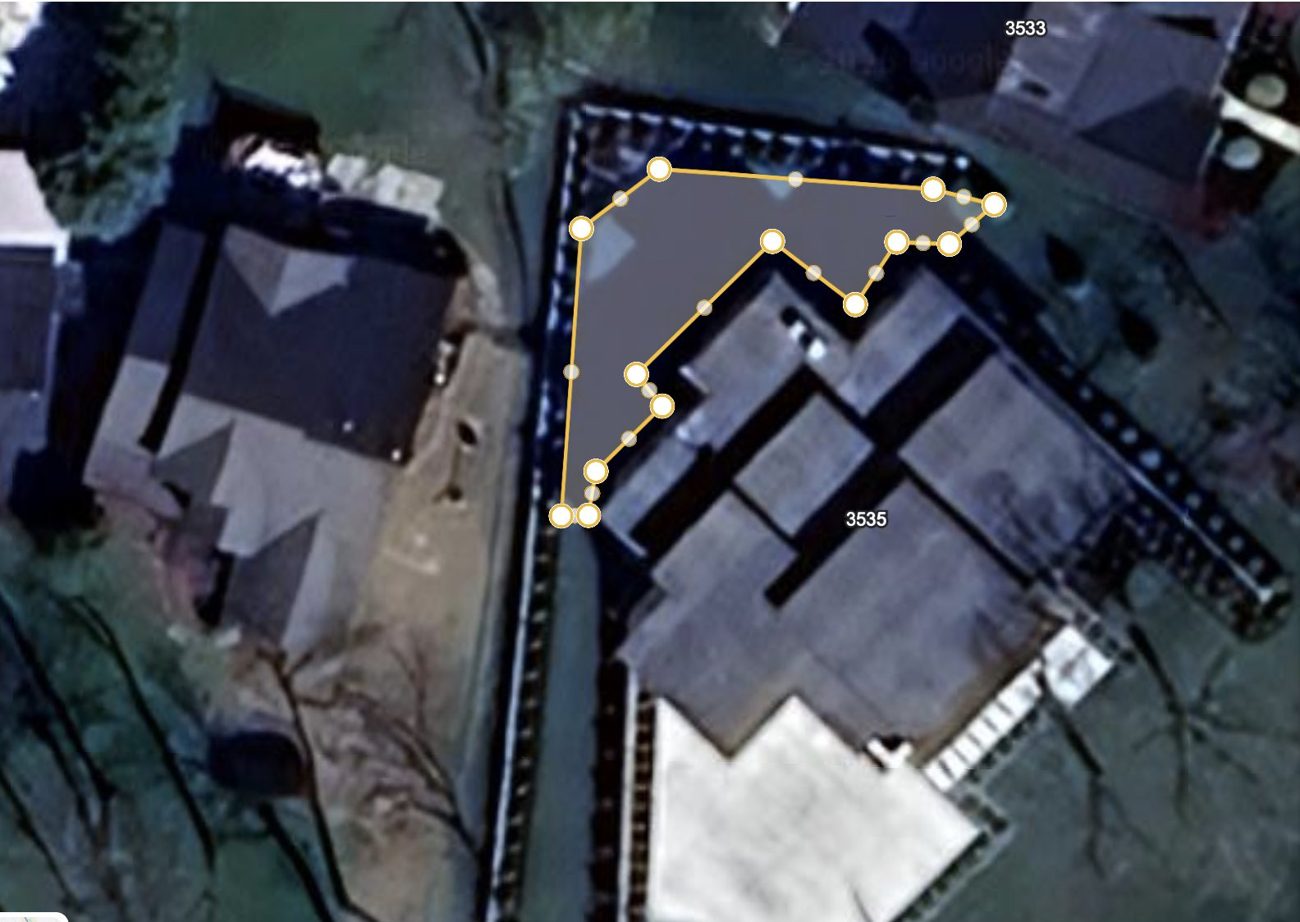
The problem
The wall is the symptom. The cause is the roof. The gutters and downspouts on this house run through 4-inch PVC straight into a rain garden in the back bed directly above the wall — every roof on the house hitting one bed at full pressure. The rain garden overtops, the surplus goes behind and under the wall, and the retained soil turns to soup. A sewer repair under that corner months earlier had also taken the wall’s drainage stone with it and never put it back properly.
Rebuilding the wall without fixing the water is a five-figure wall that fails the same way. So this proposal doesn’t rebuild the wall. It fixes what’s pushing on it.
What we’re building
Metro Nashville’s stormwater manual calls a stone trench with a perforated pipe in it a Modified French Drain. Instead of a pipe that fires the roof at the rain garden, we build the whole back yard as one — under synthetic turf.
| Layer | Spec |
|---|---|
| Synthetic turf | Premium natural-look residential turf with a permeable backing, staked and seamed, infill to manufacturer spec |
| Leveling course | Compacted fine chip, screeded to grade |
| Reservoir base | 4–6 in. of clean, open-graded stone — no fines — sloped 0.5–2% toward the back corner so it stores, perks and moves water instead of holding it |
| Collector pipe | Perforated pipe in the stone, wrapped in filter fabric, falling toward the back corner; cleanout at the head of each run |
| Separation | Non-woven geotextile between subgrade and stone — keeps soil out of the stone so it can’t clog the way the old drain did |
| Subgrade | Cut to depth, shaped to drain, compacted |
How the water moves: the 4-inch PVC to the back bed comes out and the downspouts discharge into the stone base at the house. Rain on the yard drops through the turf into the stone. The base stores the storm, lets a good share perk into the ground, and walks the rest through the collector runs at a gentle slope to the rain garden — which is untouched, and goes back to being a bed that’s damp for a day after a storm instead of a pond. Same water, same destination, a fraction of the speed. Irrigation in the turf footprint is capped; the areas where equipment tracks in and out get graded, seeded and strawed on the way out.
What’s not in scope, and why
The wall stays as it is. If it keeps moving after the water is off it, that’s a different conversation — but we don’t expect it to, and we’d rather the money go to the cause than the symptom. Anything on the neighbor’s side of the line, irrigation re-zoning beyond capping, and any engineering or Metro Water Services review of the discharge point are outside this scope. We photograph the void before we fill it.
Questions to ask anyone who quotes this
| Ask | Why it matters |
|---|---|
| Where does the roof water go after you’re done? | If the answer is “the rain garden, like now,” nothing has changed. |
| What stone is in the turf base, and is it washed? | Crusher run and screenings pack tight and hold water. A drainage base is clean, open-graded stone. |
| Is there fabric between the soil and the stone? | Without it, soil migrates into the stone and the base clogs — that’s what happened to the wall’s drain. |
| Where does the base discharge, and at what slope? | Stone that doesn’t fall to an outlet is a bathtub. Metro’s MFD spec is 0.5% minimum. |
| Are you fixing the water, or selling me a wall? | A rebuild without fixing the roof water fails the same way. |
How we build it
Read more on artificial turf installation, our retaining wall work, and retaining wall materials for Tennessee soil. Drainage behind a wall is the part of a wall job nobody photographs and the part that decides whether it’s standing in ten years.
Green Hills
Green Hills lots slope, and the newer infill houses sit on cut-and-fill pads with segmental walls holding the back yard up. The combination of a tight lot, a big roof and a builder-installed drainage run that fires everything at one spot is one we see over and over in 37215. The fix is almost never the wall.
Thinking about the same thing for your back yard? Call (615) 356-0139 or request a free quote. We come out, look at it, and tell you straight what it needs.